
Category: Uncategorized

  •  The Tax- Oddity:Ground Control to Major Metadata

    Look, I don’t want to alarm you, but your organization’s metadata taxonomy is likely currently floating somewhere beyond the orbit of structured usability, held together with digital duct tape, forgotten sticky notes, and the desperate prayers of that one person in IT who’s been there since the Space Shuttle era. And now you want to add AI to this situation? 

    Commencing countdown, engines on

     (Abort! Abort!)

    Every company these days is racing to launch AI automation like they’re trying to beat SpaceX to Mars. Marketing teams are promising “intelligent auto-tagging that’s out of this world.” Operations is hyping “machine learning-powered classification at light speed.” Your CEO just came back from a conference and won’t stop saying “we need to reach for the stars with AI transformation.”Fast forward six months: Your AI has confidently tagged the CEO’s headshot as “moon rock,” classified the annual report as “UFO debris,” and somehow put every single customer record into a category called “unidentified_temp_final_FINAL_v2.” The AI didn’t fail you. You failed to complete your pre-flight checklist. You launched a rocket without checking if the fuel tank was full of Tang  instead of actual rocket fuel.

    For here am I sitting in a tin can:
     Current State Assessment

    Let’s talk about your current metadata situation, shall we? 

    You’ve got schemas that look like they were designed by aliens who’ve never actually visited Earth, communicated only through mysterious crop circles, and were actively gaslighting humanity. Your taxonomy has more branches than the Milky Way has stars and less logic than flat-Earth theory. You have categories called “MISC,” “OTHER,” “STUFF,” “THINGS,” and my personal favorite “idk_ask_janet (she retired to Florida in 2017).” Different departments invented their own classification systems because apparently inter-departmental communication requires more coordination than a Mars landing. Finance calls it a “revenue stream.” Marketing calls it a “customer journeys.” Sales calls it “that thing with the money from the people.” They’re all talking about the same process, but good luck getting your AI to navigate that constellation of confusion. It’s taxonomy chaos out there in the void, and you want to hand the controls to an autopilot system?


    And I think my spaceship knows which way to go:
     AI Mistakes at Warp Speed Since 2023

    Here’s the thing about AI that the vendors don’t emphasize in their glossy rocket-launch presentations: AI is *really, really good* at being confidently wrong at an astronomical scale.A human might look at your confusing category structure, scratch their head, maybe grab a coffee from the space station cafeteria, radio a colleague, and make a thoughtful decision. An AI will look at that same confusion and think, “You know what? I’m going to categorize 10,000 documents in the next batch using a system I learned from your  garbage data, and I’m going to feel GREAT about it.” It’s like giving a rookie astronaut the controls during re-entry. Sure, they’ll make things happen fast. But do you want them navigating through the atmosphere when they think “heat shields” are optional equipment?


    Your AI will boldly go where no metadata has gone before straight into a black hole of misclassification.

    Take your protein pills and put your helmet on:
      (AKA: NASA Didn’t Skip the Safety Checks)


    Before you can responsibly blast AI off into your metadata galaxy, you need to do some deeply unglamorous ground control work. I’m talking about the kind of preparation that makes countdown procedures look thrilling.

    Mission Phase 1:

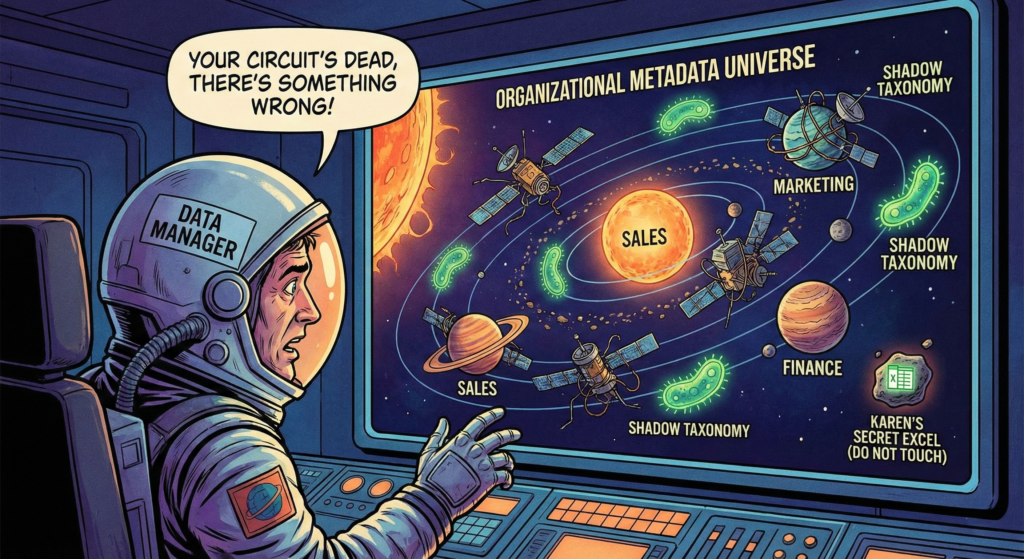
    Your circuit’s dead, there’s something wrong

    You need to map every single classification scheme floating around your organizational solar system. And yes, I mean *every* one including the secret Excel spreadsheet that Karen in accounting has been maintaining in her own isolated space station for eight years that’s somehow become mission-critical to the entire enterprise. You’ll discover shadow taxonomies orbiting everywhere. It’s like finding out your organization has been colonized by rogue metadata bacterias that have been building their own classification systems in the outer reaches when Ground Control wasn’t looking.
    Mission Phase 2:

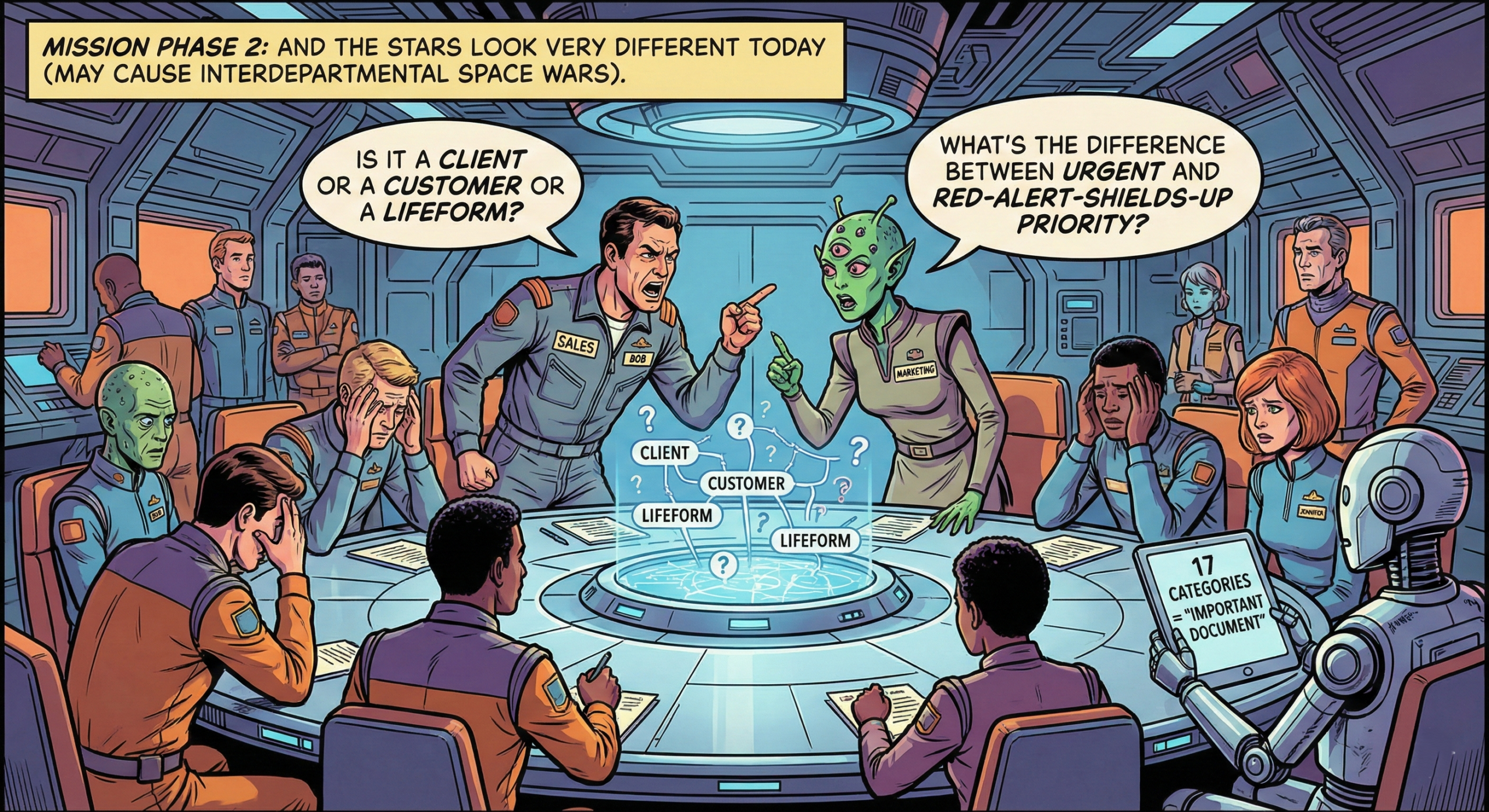
    And the stars look very different today

    Now comes the part where you get everyone in the shuttle bay and make them agree on things. “Is it a client or a customer or a lifeform?”
    “What’s the difference between urgent and red-alert-shields-up priority?”
    “Why do we have seventeen categories that all translate to ‘important document’?” This process will reveal that Bob in sales and Jennifer in marketing have been using the same terms to mean completely different things for six years, like they’re speaking different languages, and honestly, it’s a miracle the mothership still functions.
    Mission Phase 3:

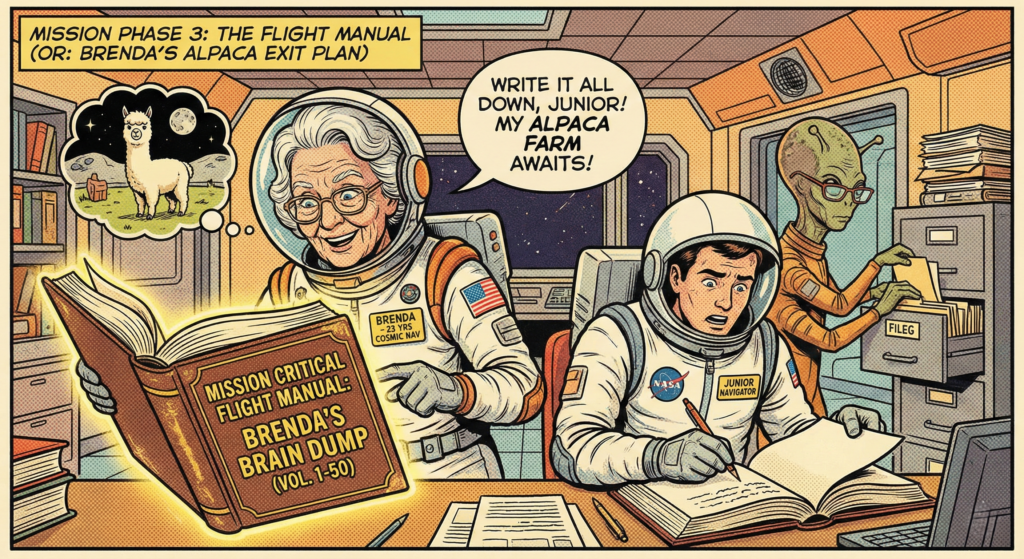
    The Flight Manual (Even Though You’d Rather Be Flying)

    All that wisdom trapped in Brenda’s brain from her 23 years navigating this organization’s cosmos? It needs to become actual, written-down, mission-critical documentation. Because when Brenda retires to her alpaca farm on Earth (or possibly a moon colony), you can’t exactly train your AI on “well, Brenda would’ve known which quadrant to file that in. Document everything like you’re leaving instructions for the next crew. Make it explicit. Yes, it’s boring. But so is running out of oxygen mid-mission, and look how much you want to avoid *that*.

    Mission Phase 4:

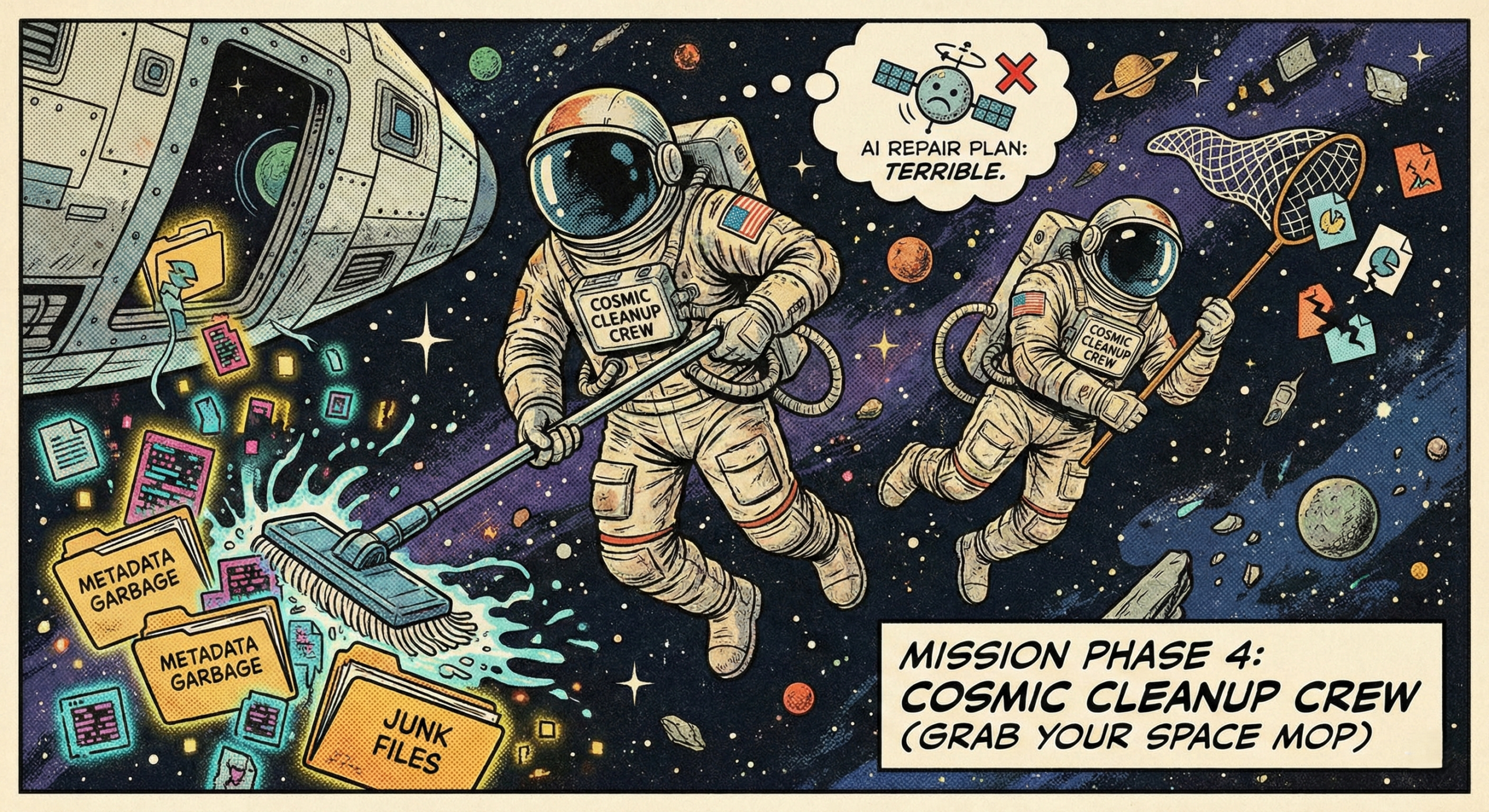
    Cosmic Cleanup Crew (Grab Your Space Mop)

    Someone needs to go through your existing data and fix it. Manually. Yes, *manually*. I know you wanted AI to do this part, but that’s like asking a satellite to repair itself while it’s already tumbling through space. Inspiring concept, terrible plan. This is your space debris cleanup mission. Not glamorous, but absolutely essential if you don’t want your AI crashing into metadata garbage at 17,000 miles per hour.
    Cinematic Plot Twist:
     Autopilot Still Needs a Pilot

    Here’s the part that’ll really send you into orbit: Even AFTER you implement AI automation and achieve liftoff, you can’t just engage autopilot and take a nap in cryosleep. You need humans at Mission Control. Forever. I’m sorry, I know that’s not what the vendor’s moonshot presentation promised. Think of it this way: AI is like an enthusiastic robot co-pilot who works at light speed but occasionally needs someone to say, “Hey, maybe don’t navigate us directly into that sun” or “That’s not a landing pad.”

    You need Ground Control because:

    Missions change mid-flight

    (remember when Pluto was a planet?)

    AI can develop weird orbital patterns

    (like that time an algorithm decided everything round was the moon)

    Someone has to catch the errors before they become lost-in-space legends

    Now it’s time to leave the capsule if you dare:
     Governance

    And finally *finally* after you’ve cleaned your metadata, launched your AI, and established your Mission Control oversight, you need governance to make sure this whole operation doesn’t float off course once solo space walks are granted . You need:Regular system checks (Yes, more checks. Even astronauts hate them.) Clear chain of command (Someone has to be Mission Commander, and “everyone” means “nobody”) Course correction procedures (Your metadata universe is expanding; you need navigation updates)Crew training programs (New astronauts will absolutely press the wrong button without proper training)Without governance, you’re just building tomorrow’s space debris field. With better technology this time, which honestly just means the wreckage will be visible from further away.

    Can you hear me, Major Tom?:
     Mission Log


    Want your AI automation to achieve orbit? Here’s your pre-flight checklist:
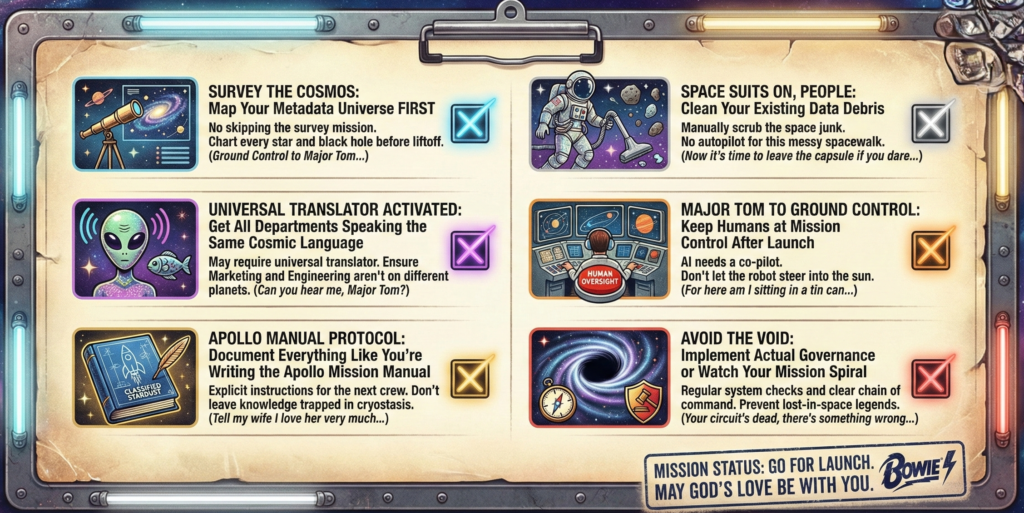
    Do the ground work now, or do expensive space rescue operations later. Your choice, Commander.

    *Next transmission: So you’ve got your AI rocket fueled and ready for launch. Fantastic! Now let me tell you about the critical countdown step everyone skips, the one that determines whether your AI becomes a reliable navigation system or an extremely confident autopilot that thinks crashing is just “alternative landing.” Spoiler: There’s more to training than just hitting “Launch Sequence Initiated” and hoping you don’t end up on the dark side of the moon.*

  • August Native Federal Grant Oversight News & Affects Explained.

    August Native Federal Grant Oversight News & Affects Explained.

    Native American tribal communities are closely watching changes in federal grant policy. The White House recently unveiled a major overhaul of federal grant rules

    The “Improving Oversight of Federal Grantmaking” initiative

    Which represents the biggest change to grant policy in over a decade gtlaw.com. Announced via Executive Order on August 7, 2025, this long-anticipated update directs government agencies and the Office of Management and Budget (OMB) to tighten grant oversight and streamline the grantmaking process aha.orgfeldesman.com.

    It’s intended to reduce red tape, strengthen oversight, and ensure federal dollars are used more effectively across the board. This guidance applies government-wide, affecting states, cities, nonprofits, and tribal governments alike brookings.edu  but as someone who works closely with Native American tribes, I want to focus on what it means for tribal communities in particular.

    My Take on the New Grant Oversight Changes

    In my professional opinion, this update to the OMB Uniform Guidance (2 CFR Part 200) is not about cutting anyone’s funding – it’s about making the system work better. The focus is on a few key areas:

    Reducing administrative burden and jargon:
    •  Agencies are now directed to simplify grant paperwork and write funding announcements in plain language gtlaw.com. Grant applications have long been notoriously complex, favoring those who can afford expert grant writers whitehouse.gov. Smoother, clearer instructions are a welcome change that can help smaller or under-resourced communities navigate grants more easily.
    Improving how data informs funding decisions:
    •  The new rules emphasize results. For example, agencies will include clear benchmarks for measuring a grant’s progress and success aha.org. In practice, this means funding decisions will lean more on solid data and demonstrated outcomes, not just a well-written proposal. You might start seeing more requirements to report measurable goals and outcomes so funders can track impact.
    Increasing financial transparency and compliance:
    •  Expect a stronger spotlight on how money is spent. The guidance calls for tighter auditing and oversight of grant funds. Agencies can even require more detailed justifications for spending for instance, some grants may now come with provisions that you must get approval before drawing down funds and explain why the money is needed feldesman.com. All of this is to ensure accountability: that every dollar is accounted for and used as intended.
     Ensuring funds reach the intended communities: 
    • There’s a clear intent to crack down on waste and make sure funds benefit the people and causes they’re meant to support. Federal officials explicitly want to stop frivolous or “off-mission” grants whitehouse.gov. At the same time, agencies are being encouraged to spread grants to a broader range of recipients, not just the same big universities or nonprofits that win every year aha.org. In theory, this could level the playing field so that smaller tribes and grassroots organizations have a fairer shot at funding.

    What Native American Tribes Need to Know

    Based on my experience guiding tribal governments through complex grant systems, here are the most important takeaways for tribes right now:

    Current Tribal Grants Are Still in Place:

     If your tribe already has an awarded grant, you are not in danger of suddenly losing it. The new rules do not claw back existing funds. However, you may notice some changes in how you have to report, track, or manage those funds as agencies implement the guidance.
    For example, federal agencies have been instructed to add “termination for convenience” clauses (allowing an award to be ended if it no longer meets program goals) to existing grants. In reality, such clauses have rarely been used successfully in the past. In short, your current funding should remain safe as long as you continue to follow the rules – just be prepared for a bit more paperwork or new terms and conditions aimed at oversight.

    Future Grants Might Be Easier to Access, But Come with Higher Expectations:

     One positive change is that the language of grant announcements and rules will be more accessible. The guidance is written to be more user-friendly (less bureaucratic jargon), which is great news for smaller tribes with limited grant-writing capacity. Funding opportunities should also open up to more players. Agencies are directed to consider a wide array of worthy applicants rather than defaulting to the same repeat winners. However, be ready for funders to look more closely at how you spend every dollar. Oversight will be stricter going forward.
    For example, some agencies may now require you to get prior approval before drawing down grant funds and to provide written justifications for each withdrawal. In practice, this means you’ll need strong internal controls and audit-ready systems. The money might be easier to apply for, but there will be higher expectations on demonstrating that it’s used properly and effectively.

    Tribal Sovereignty and Eligibility Remain Unchanged:

      Nothing in this update diminishes the federal trust responsibility or a tribe’s right to seek federal grants. Tribes still have a unique government-to-government relationship with the U.S., and the obligations to support tribal communities still firmly stand. The new rules do not place any new limitations on tribes’ eligibility for funding. If anything, the push to broaden who receives grants could mean more opportunities for tribal programs that have been overlooked in the past. I also anticipate we’ll see additional support (like training and outreach) to help tribes build the internal systems needed to meet the new requirements. At face value, your political sovereignty and your ability to go after federal funding are as strong as ever under this policy update.

    3 Steps Tribal Governments Should Take Now

    Change can be overwhelming, but there are concrete steps tribal governments can take right now to adapt and thrive under the new grant oversight landscape:

    1. Keep a Close Eye on Agency-Specific Changes: Every federal agency will roll out this guidance in its own way and on its own timeline. I highly recommend assigning someone on your team to monitor the Federal Register and updates from the agencies that fund your programs. Watch for new Notice of Funding Opportunity (NOFO) announcements or rule tweaks. (In fact, some agencies might pause or slow down new grant announcements briefly until they sort out their review processes feldesman.com. By keeping informed, you’ll have more lead time to adjust to any new application requirements or reporting rules. Knowledge is power, the sooner you know about a change, the more time you have to comply or pivot.
    2. Evaluate and Strengthen Your Internal Processes: This is the perfect moment to take an honest look at how your tribal administration handles grant management. Are your grant files organized and complete? Do you have up-to-date policies for budgeting, procurement, and record-keeping? If an auditor reviewed your program tomorrow, would you be confident in the outcome? The new federal guidance puts a premium on accountability. For example, agencies may now insert language in grants that prohibits drawing down funds without explicit approval and detailed justification feldesman.com. That means every transaction might face scrutiny. Use this time to shore up your financial tracking and compliance procedures. If you identify gaps such as staff need training on 2 CFR Part 200 rules, or you need to implement a better system for documenting expenditures, don’t wait. Invest in those improvements now. It’s much easier to handle increased oversight if your house is already in order. And if you need outside help (consultants, auditors, etc.) to get audit-ready, consider bringing them in sooner rather than later.
    3. Take Advantage of Technical Assistance and Training: You do not have to navigate these changes alone. Many federal agencies offer free training, tools, and technical assistance for their grantees and tribes are often a priority for outreach. For instance, the Department of Justice’s Tribal Financial Management Center provides no-cost training and one-on-one technical assistance to help tribal grant recipients manage their funds properly ojp.gov. They’ll even assist with things like improving financial policies or preparing for grant audits. Other departments (HUD, HHS, EPA, etc.) have similar programs dedicated to tribal capacity-building ojp.gov. Make it a point to seek out these resources. Attend webinars, ask your grant program officers about training sessions, and connect with peer networks. By boosting your team’s grant management skills, you’ll not only meet the new oversight expectations, you’ll also position your tribe to excel (and maybe even to win more grants) in the long run.

    Final Thoughts

    From my perspective, this oversight, as written, is not bad news for tribes. It’s a wake-up call, yes, but also an opportunity.

    The goal is to ensure federal funds truly serve our communities, something we can all get behind. By proactively adjusting to the new rules, tribes can actually end up in a stronger position than before. The simplified application processes and emphasis on plain language are likely to make it easier for many Native organizations to compete for grants on a more level playing field whitehouse.govgtlaw.com. And while the government will be watching spending more closely, that isn’t a threat if you’re prepared it’s a chance to shine by showcasing the great work you are doing with every federal dollar. 

    Most importantly, remember that tribal sovereignty remains intact.

    The U.S. government still has a duty to work with and fund tribal nations for the betterment of Native people brookings.edu. This update doesn’t change that, if anything, it reinforces the importance of getting funds out to the people who need them and to be used in the right way. My advice is to embrace the spirit of these changes. Use them to modernize your grant strategies, tighten up any loose ends in administration, and double down on outcomes that matter to your community. 

    Change can be daunting, but it can also be empowering. If your tribe wants help navigating the new compliance terrain or strategizing how to take advantage of the evolving grant landscape, please know that I’m here to support you. We have a unique opportunity right now to proactively adapt and thrive, ensuring that federal funding continues to flow to Indian Country and makes an even bigger impact. Let’s commit to turning this policy update into a positive force for our tribes’ future.

     We’ve got this, and I’m excited to see Native communities benefit from a grant system that works better, fairer, and more transparently for everyone. 

    – Mule Deer Consulting, Grant Professionals and Advocates for Indigenous Communities 

    #NativeAmericanTribes #TribalFunding #FederalGrants #GrantCompliance #TribalSovereignty #OMBUpdate #Nonprofits #IndigenousLeadership

    Citations

    Office of Management and Budget Releases Significant Changes to the Uniform Guidance | Insights | Greenberg Traurig LLP

    https://www.gtlaw.com/en/insights/2024/4/office-of-management-and-budget-releases-significant-changes-to-the-uniform-guidanceAdministration announces effort to improve federal grantmaking oversight | AHA Newshttps://www.aha.org/news/headline/2025-08-08-administration-announces-effort-improve-federal-grantmaking-oversightNew Executive Order Mandates More Federal Funding Scrutinyhttps://www.feldesman.com/new-executive-order-mandates-more-federal-funding-scrutiny/A federal grant freeze could disrupt over $24 billion to Native American communities and undermine US obligations to Tribes | Brookingshttps://www.brookings.edu/articles/a-federal-grant-freeze-could-disrupt-over-24-billion-to-native-american-communities-and-undermine-us-obligations-to-tribes/Office of Management and Budget Releases Significant Changes to the Uniform Guidance | Insights | Greenberg Traurig LLPhttps://www.gtlaw.com/en/insights/2024/4/office-of-management-and-budget-releases-significant-changes-to-the-uniform-guidanceImproving Oversight of Federal Grantmaking – The White Househttps://www.whitehouse.gov/presidential-actions/2025/08/improving-oversight-of-federal-grantmaking/Administration announces effort to improve federal grantmaking oversight | AHA Newshttps://www.aha.org/news/headline/2025-08-08-administration-announces-effort-improve-federal-grantmaking-oversightNew Executive Order Mandates More Federal Funding Scrutinyhttps://www.feldesman.com/new-executive-order-mandates-more-federal-funding-scrutiny/Fact Sheet: President Donald J. Trump Stops Wasteful Grantmaking – The White Househttps://www.whitehouse.gov/fact-sheets/2025/08/fact-sheet-president-donald-j-trump-stops-wasteful-grantmaking/Administration announces effort to improve federal grantmaking oversight | AHA Newshttps://www.aha.org/news/headline/2025-08-08-administration-announces-effort-improve-federal-grantmaking-oversightNew Executive Order Mandates More Federal Funding Scrutinyhttps://www.feldesman.com/new-executive-order-mandates-more-federal-funding-scrutiny/A federal grant freeze could disrupt over $24 billion to Native American communities and undermine US obligations to Tribes | Brookingshttps://www.brookings.edu/articles/a-federal-grant-freeze-could-disrupt-over-24-billion-to-native-american-communities-and-undermine-us-obligations-to-tribes/New Executive Order Mandates More Federal Funding Scrutinyhttps://www.feldesman.com/new-executive-order-mandates-more-federal-funding-scrutiny/Tribal Financial Management Center | Office of Justice Programshttps://www.ojp.gov/training-and-technical-assistance/tfmcTribal Financial Management Center | Office of Justice Programshttps://www.ojp.gov/training-and-technical-assistance/tfmc