
Look, I don’t want to alarm you, but your organization’s metadata taxonomy is likely currently floating somewhere beyond the orbit of structured usability, held together with digital duct tape, forgotten sticky notes, and the desperate prayers of that one person in IT who’s been there since the Space Shuttle era. And now you want to add AI to this situation?
Commencing countdown, engines on
(Abort! Abort!)
Every company these days is racing to launch AI automation like they’re trying to beat SpaceX to Mars. Marketing teams are promising “intelligent auto-tagging that’s out of this world.” Operations is hyping “machine learning-powered classification at light speed.” Your CEO just came back from a conference and won’t stop saying “we need to reach for the stars with AI transformation.”Fast forward six months: Your AI has confidently tagged the CEO’s headshot as “moon rock,” classified the annual report as “UFO debris,” and somehow put every single customer record into a category called “unidentified_temp_final_FINAL_v2.” The AI didn’t fail you. You failed to complete your pre-flight checklist. You launched a rocket without checking if the fuel tank was full of Tang instead of actual rocket fuel.
For here am I sitting in a tin can:
Current State Assessment
Let’s talk about your current metadata situation, shall we?
You’ve got schemas that look like they were designed by aliens who’ve never actually visited Earth, communicated only through mysterious crop circles, and were actively gaslighting humanity. Your taxonomy has more branches than the Milky Way has stars and less logic than flat-Earth theory. You have categories called “MISC,” “OTHER,” “STUFF,” “THINGS,” and my personal favorite “idk_ask_janet (she retired to Florida in 2017).” Different departments invented their own classification systems because apparently inter-departmental communication requires more coordination than a Mars landing. Finance calls it a “revenue stream.” Marketing calls it a “customer journeys.” Sales calls it “that thing with the money from the people.” They’re all talking about the same process, but good luck getting your AI to navigate that constellation of confusion. It’s taxonomy chaos out there in the void, and you want to hand the controls to an autopilot system?
And I think my spaceship knows which way to go:
AI Mistakes at Warp Speed Since 2023
Here’s the thing about AI that the vendors don’t emphasize in their glossy rocket-launch presentations: AI is *really, really good* at being confidently wrong at an astronomical scale.A human might look at your confusing category structure, scratch their head, maybe grab a coffee from the space station cafeteria, radio a colleague, and make a thoughtful decision. An AI will look at that same confusion and think, “You know what? I’m going to categorize 10,000 documents in the next batch using a system I learned from your garbage data, and I’m going to feel GREAT about it.” It’s like giving a rookie astronaut the controls during re-entry. Sure, they’ll make things happen fast. But do you want them navigating through the atmosphere when they think “heat shields” are optional equipment?
Your AI will boldly go where no metadata has gone before straight into a black hole of misclassification.
Take your protein pills and put your helmet on:
(AKA: NASA Didn’t Skip the Safety Checks)
Before you can responsibly blast AI off into your metadata galaxy, you need to do some deeply unglamorous ground control work. I’m talking about the kind of preparation that makes countdown procedures look thrilling.
Mission Phase 1:
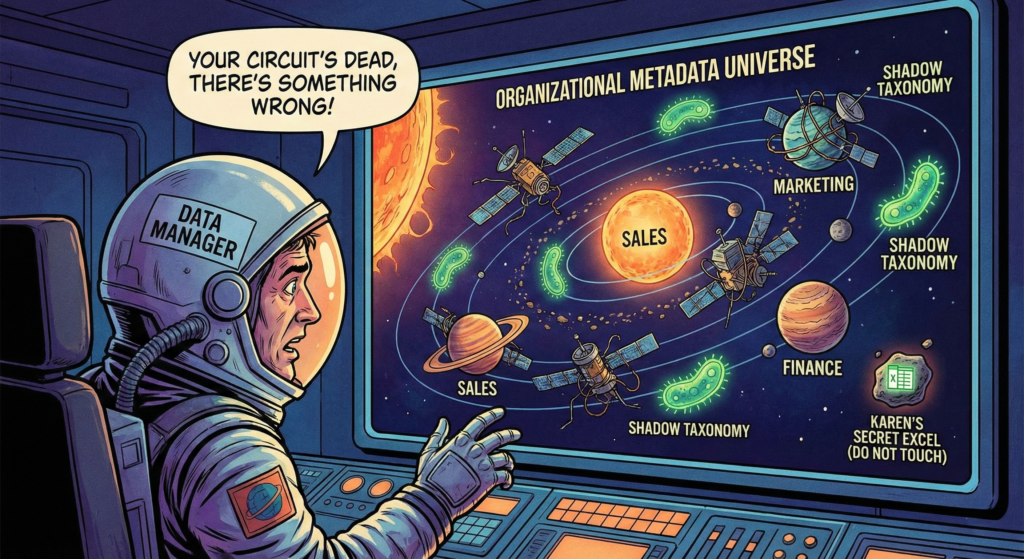
Your circuit’s dead, there’s something wrong
You need to map every single classification scheme floating around your organizational solar system. And yes, I mean *every* one including the secret Excel spreadsheet that Karen in accounting has been maintaining in her own isolated space station for eight years that’s somehow become mission-critical to the entire enterprise. You’ll discover shadow taxonomies orbiting everywhere. It’s like finding out your organization has been colonized by rogue metadata bacterias that have been building their own classification systems in the outer reaches when Ground Control wasn’t looking.
Mission Phase 2:
And the stars look very different today
(May Cause Interdepartmental Space Wars)
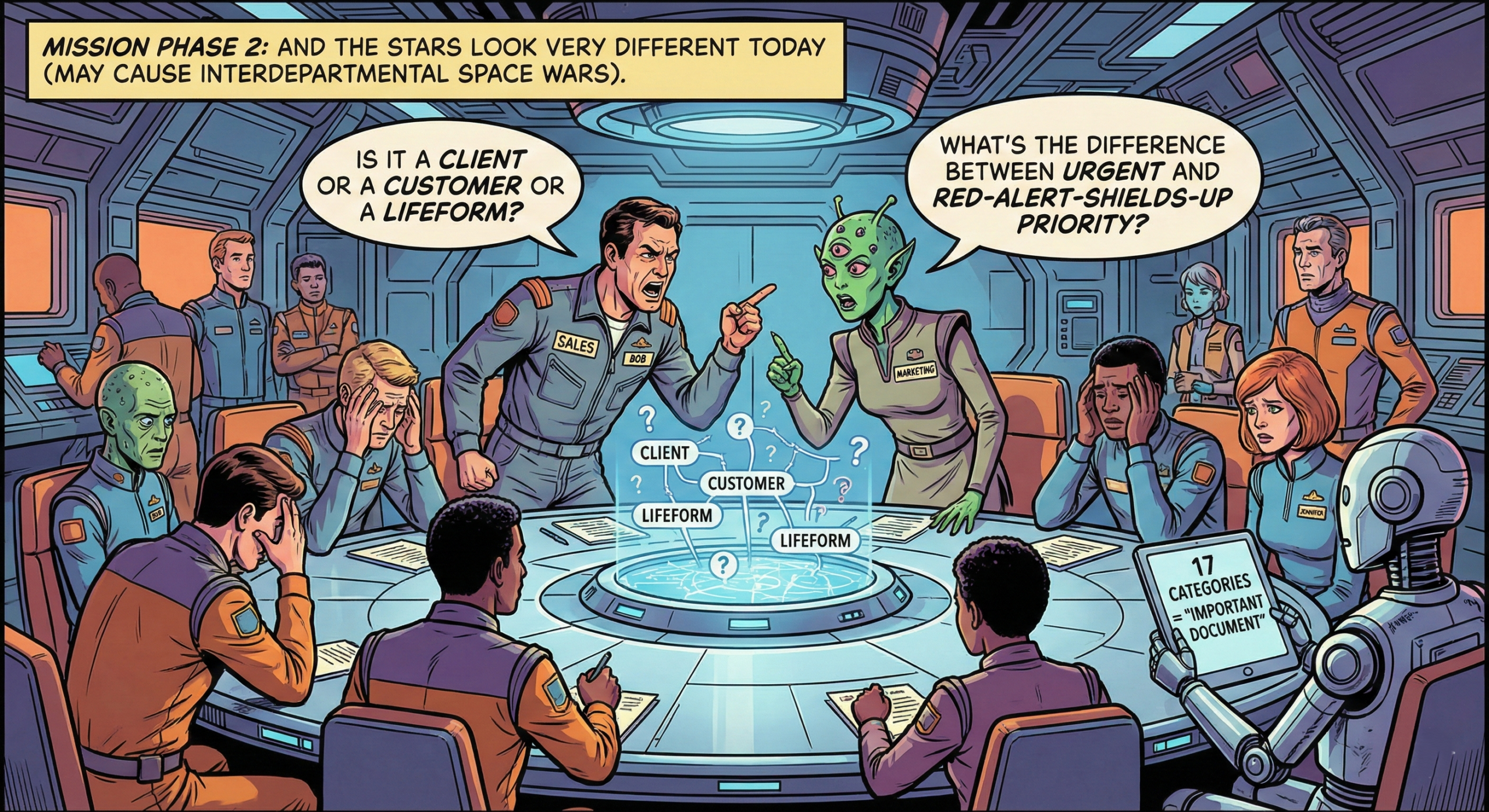
Now comes the part where you get everyone in the shuttle bay and make them agree on things. “Is it a client or a customer or a lifeform?”
“What’s the difference between urgent and red-alert-shields-up priority?”
“Why do we have seventeen categories that all translate to ‘important document’?” This process will reveal that Bob in sales and Jennifer in marketing have been using the same terms to mean completely different things for six years, like they’re speaking different languages, and honestly, it’s a miracle the mothership still functions.
Mission Phase 3:
The Flight Manual (Even Though You’d Rather Be Flying)
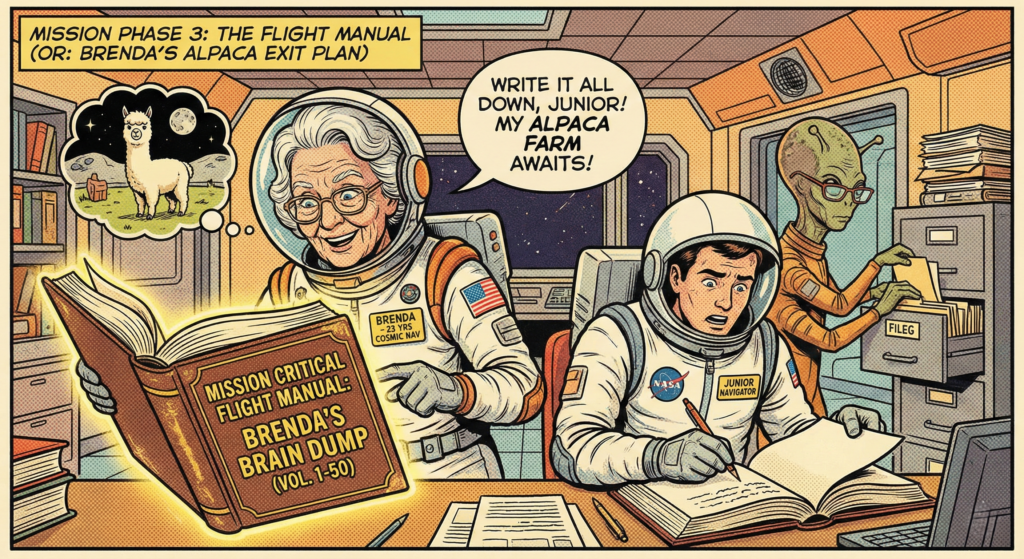
All that wisdom trapped in Brenda’s brain from her 23 years navigating this organization’s cosmos? It needs to become actual, written-down, mission-critical documentation. Because when Brenda retires to her alpaca farm on Earth (or possibly a moon colony), you can’t exactly train your AI on “well, Brenda would’ve known which quadrant to file that in. Document everything like you’re leaving instructions for the next crew. Make it explicit. Yes, it’s boring. But so is running out of oxygen mid-mission, and look how much you want to avoid *that*.
Mission Phase 4:
Cosmic Cleanup Crew (Grab Your Space Mop)
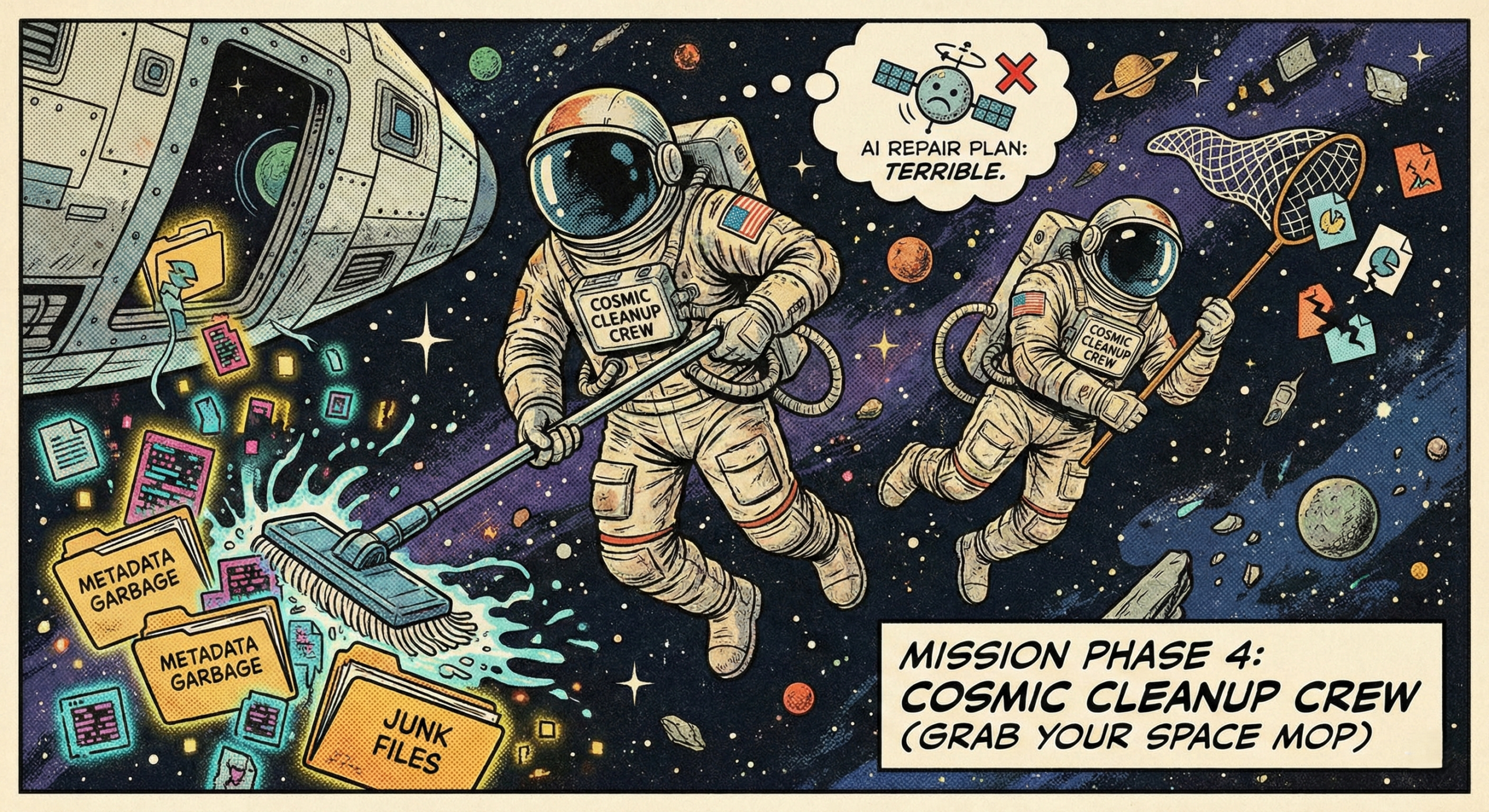
Someone needs to go through your existing data and fix it. Manually. Yes, *manually*. I know you wanted AI to do this part, but that’s like asking a satellite to repair itself while it’s already tumbling through space. Inspiring concept, terrible plan. This is your space debris cleanup mission. Not glamorous, but absolutely essential if you don’t want your AI crashing into metadata garbage at 17,000 miles per hour.
Cinematic Plot Twist:
Autopilot Still Needs a Pilot
Here’s the part that’ll really send you into orbit: Even AFTER you implement AI automation and achieve liftoff, you can’t just engage autopilot and take a nap in cryosleep. You need humans at Mission Control. Forever. I’m sorry, I know that’s not what the vendor’s moonshot presentation promised. Think of it this way: AI is like an enthusiastic robot co-pilot who works at light speed but occasionally needs someone to say, “Hey, maybe don’t navigate us directly into that sun” or “That’s not a landing pad.”
You need Ground Control because:
Missions change mid-flight
(remember when Pluto was a planet?)
AI can develop weird orbital patterns
(like that time an algorithm decided everything round was the moon)
Someone has to catch the errors before they become lost-in-space legends
Now it’s time to leave the capsule if you dare:
Governance
And finally *finally* after you’ve cleaned your metadata, launched your AI, and established your Mission Control oversight, you need governance to make sure this whole operation doesn’t float off course once solo space walks are granted . You need:Regular system checks (Yes, more checks. Even astronauts hate them.) Clear chain of command (Someone has to be Mission Commander, and “everyone” means “nobody”) Course correction procedures (Your metadata universe is expanding; you need navigation updates)Crew training programs (New astronauts will absolutely press the wrong button without proper training)Without governance, you’re just building tomorrow’s space debris field. With better technology this time, which honestly just means the wreckage will be visible from further away.
Can you hear me, Major Tom?:
Mission Log
Want your AI automation to achieve orbit? Here’s your pre-flight checklist:
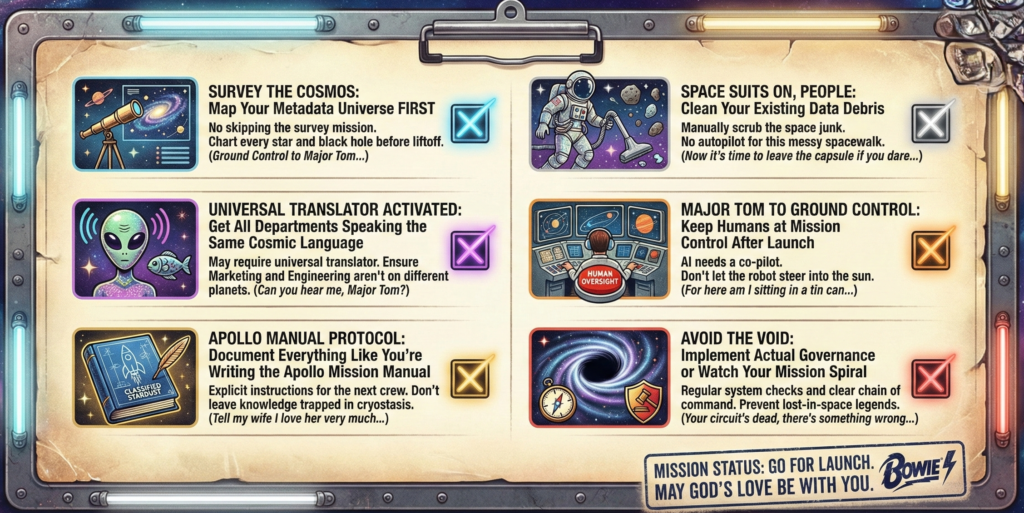
Do the ground work now, or do expensive space rescue operations later. Your choice, Commander.
*Next transmission: So you’ve got your AI rocket fueled and ready for launch. Fantastic! Now let me tell you about the critical countdown step everyone skips, the one that determines whether your AI becomes a reliable navigation system or an extremely confident autopilot that thinks crashing is just “alternative landing.” Spoiler: There’s more to training than just hitting “Launch Sequence Initiated” and hoping you don’t end up on the dark side of the moon.*
August Native Federal Grant Oversight News & Affects Explained.
August Native Federal Grant Oversight News & Affects Explained. Native American tribal communities are closely watching changes in federal grant policy. The…
Who Owns Your Story? Meet Robert “The Tribal Website Guy”
Let’s talk about something powerful that doesn’t get nearly enough spotlight: digital sovereignty and the Native man shaking things up…
2025 ICWA Court Improvement Grants: What Tribal Courts Need to
Strengthening Sovereignty from the Bench: The ICWA Court Improvement Program Evolves In Tribal child welfare, the courtroom is more than a…
$109.4 Million Awarded to Tribal Housing Entities — What Comes
$109.4M in Tribal Housing Grants: What Comes Next? $109.4M in Tribal Housing Grants: What Comes…
Gatekeepers at Grants.gov: What DOGE’s Oversight Means for Your Funding
Gatekeepers at Grants.gov: What DOGE’s Oversight Means for Your Funding Future …
Beyond the Freeze: Are You Ready for the New Era
Beyond the Freeze: Are You Ready for the New Era of Federal Grant Compliance? …
Leave a Reply